Used Books Autmated Lighting the Art and Scinence of Moving an Colorchanging Lights
Whether you lot're hunting wild boar at night, taking a moonlit walk through the woods, running some kind of covert operation, or simply trying to discover the bathroom in an unfamiliar house or hotel, it can be advantageous to be able to see well in the nighttime.
You could fire upwards a flashlight to accomplish that purpose, but that has its disadvantages, including letting the thing yous're hunting know where you are, and, ironically, actually diminishing your power to see in the dark.
You lot could also put on some fancy night-vision goggles if you wanted to get loftier-tech about information technology and had the money.
Only your natural, naked center has its own night-vision capabilities that are actually pretty top-notch — if you know how to enhance and harness them.
How We See in the Dark
Understanding how nosotros encounter in the dark tin can better aid us understand what nosotros can do to maintain our vision at night. Below we walk you through a thumbnail sketch of how the human eye sees in depression-light environments:
Pupil. Think of the pupil as the aperture on a photographic camera. It'due south what allows light to enter our eyes. The wider the student, the more light can come in; the narrower the pupil, the less light tin enter.
Just as the discontinuity on a camera will open up wide in low-low-cal environments to let more than light in, so too will your pupil dilate — open wide — in dark situations.
Yous may have thought of this widening/narrowing of the student equally the only machinery by which your eyes adapt to the dark. But this is but the first step in this process, and not even the most significant one. Human night vision has more to do with the eye'due south . . .
Rods and cones. Afterwards lite passes through the pupil, it goes to the dorsum of our eyeball and hits a thin layer of sensory membrane called the retina. Sticking with the old-school camera analogy, think of the retina as the camera's film. It'southward where our eyes outset putting together nerve signals to transport to our brains.
The retina is covered with two types of photoreceptors called rods and cones. They're called rods and cones because those are the shapes they respectively take.
Rods work best in depression-level lite. They just need a few photons of light to be activated. When nosotros're looking effectually in depression-light environments, our optics primarily use rods to encounter things. The downside of rods is that they don't run into color. That'southward why when you're seeing in the dark, things look more grayscale, and colors don't pop. Everything is kind of muted.
Cones require a lot more light to be activated. We accept three types of cones: scarlet, blue, and dark-green. A combination of these different cones being activated allows us to run into in colour. Most of our cones are packed in a small office of the retina called the fovea, which is at the very back of the eyeball and allows us to see images in detail.
Photopigments, specifically rhodopsin. Both rods and cones contain light-sensitive chemicals chosen photopigments. These photopigments convert light energy that hits the retina into electrical activity so that our brains tin decipher what we're seeing. Going back to our camera illustration, think of photopigments as the chemicals that help develop your picture.
Rods incorporate a photopigment chosen rhodopsin; cones comprise a photopigment chosen photopsin.
Rhodopsin is what allows united states to encounter at nighttime.
But as soon as the rhodopsin is exposed to loftier-light levels, it decomposes (aka photobleaches), reducing our sensitivity to light in low-light conditions, meaning nosotros tin can't see likewise in the nighttime. The brighter the light, the more than the rhodopsin gets bleached.
One time your eyes are exposed to less calorie-free, the rhodopsin starts to regenerate in your rods. It takes nearly 30 minutes for rhodopsin to completely restore, bringing you back to optimal night vision. Even though it takes a one-half hour for rhodopsin to fully regenerate, your eyes' ability to see in the dark volition get-go to meliorate as presently every bit they finish being exposed to the loftier levels of light that caused their rhodopsin to decompose in the beginning identify. Y'all'll notice that your low-light vision will slowly get better and better the longer you lot get used to the lower-calorie-free levels.
If you've ever experienced going from a brilliant sunny day outside to back inside your house, and everything looked really dark for several minutes despite the interior lights being on, you now tin can empathize what was happening in your eyeballs — the sunlight had photobleached your rhodopsin, leaving your eyes struggling to see in the suddenly lower-light conditions.
You may take then noticed that your vision gradually got better and better every bit you lot sabbatum in the depression-calorie-free room. That was your rhodopsin regenerating in your rods. Pretty cool, huh?
How to Maintain Your Nighttime Vision
Now that we have a rough thought of how we encounter in the night, we're better equipped to understand how to maintain our vision at night.
The overarching principle is to expose your eyes to as little bright light equally possible. Because as soon as the rhodopsin in your rods is exposed to vivid lite, information technology bleaches abroad, taking your night vision along with it. And remember, it takes a one-half hour to be fully restored!
Looking direct at light bulbs, flashlights, smartphone screens, and even a bright full moon will effect in the degeneration of your rhodopsin. So don't practice those things.
How to Maintain Night Vision While Using a Flashlight
Flashlights raise an interesting issue when it comes to maintaining night vision. When working in the night, y'all may need to use your flashlight to read directions on newspaper or look for things in your environment. Merely the use of this artificial help volition also reduce the rhodopsin in your eyes, reducing your natural ability to see in the dark.
So how can you lot utilise a flashlight or headlamp without disrupting your night vision too much?
Consider the idea that y'all may not need a flashlight after all. When you head out in the dark, you probably have an automatic instinct to reach for a flashlight and feel like wielding ane is necessary to come across what you lot're doing. And information technology does initially announced that way. Merely remember, it takes awhile for your eyes to fully adjust to the dark; if y'all requite them that chance, you may find you lot don't demand a flashlight to see after all. Especially when you're outdoors and operating under the moonlight.
Only use as much light as you need. These days, most LED flashlights allow yous to select how much light you emit from your flashlight. So if you practise apply a flashlight, select the lowest light setting possible. Remember, the brighter the light, the more your rhodopsin decomposes, so the less light you lot tin apply from your flashlight, the better.
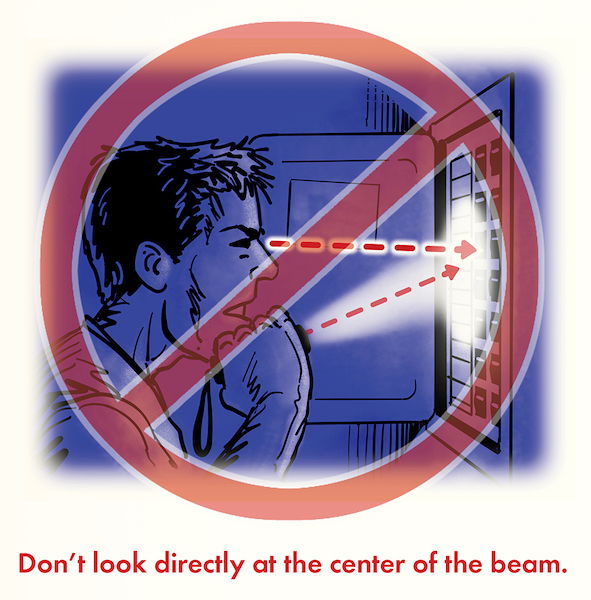
Don't look at the center of the flashlight beam. When you're pointing a flashlight at an object in your environs, y'all have the natural tendency to wait at the center of the beam. It makes sense; it's the brightest part of the light coming from a flashlight. But looking at the brightest office of the light will but accelerate the fading of your rhodopsin, and your nighttime vision along with it.
Instead of looking directly at the center of your lite beam, expect effectually its periphery.
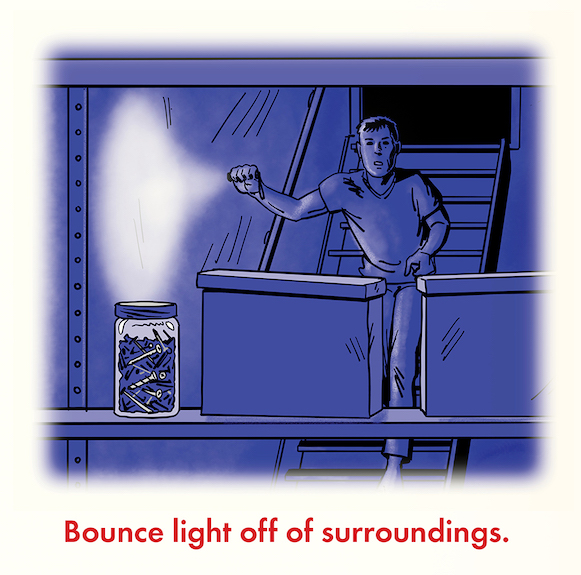
Bounciness low-cal off your surroundings. If you're in a dark room, y'all can avoid looking directly at your flashlight by bouncing the light off a wall and just using the resulting ambient calorie-free.
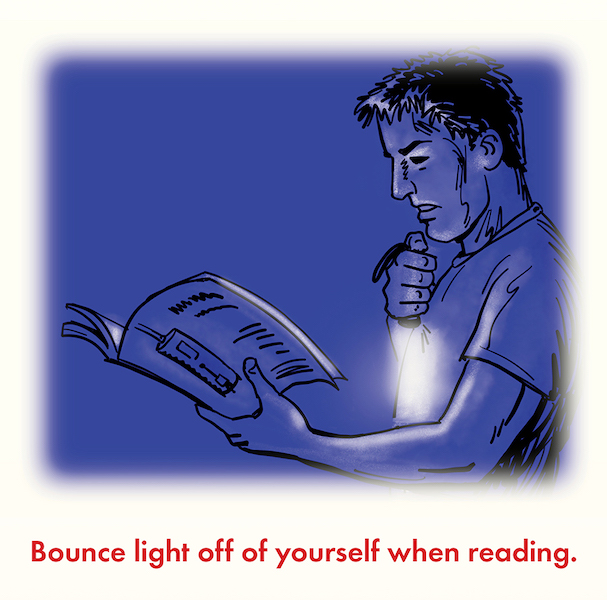
Bounce light off yourself when reading. If you lot need to read a document with your flashlight, instead of aiming the light directly at the paper and looking directly at the center of the beam, printing the bezel of your flashlight flush against your chest and tilt the light. You're effectively bouncing the light off your chest in guild to illuminate the document with much dimmer ambient light.
What About Cerise or Greenish Lights?
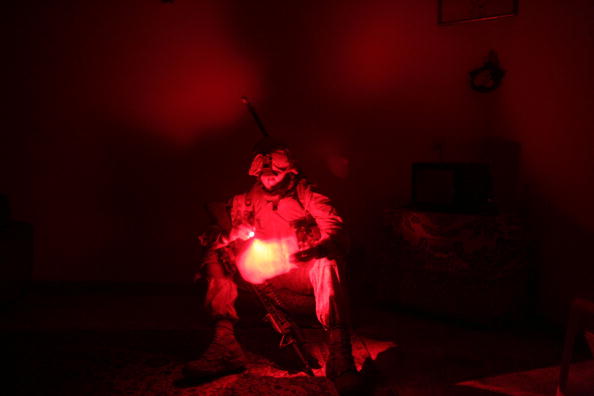
Yous may have seen war movies where a unit on a night patrol uses flashlights that emit red light. Here'southward why:
Rhodopsin is less sensitive to photobleaching from the long wavelengths of red light. Equally such, it has a reduced effect on rhodopsin as compared to white light.
While ruby-red light has been the color of choice for maintaining night vision, at that place has been a trend in the military of pivoting towards using green lite in low-light situations. Our eyes are more receptive to light-green lite, which means y'all tin run into things more conspicuously with a green light at a lower calorie-free intensity. That is, with a green lite, you don't need to have as much light coming from your flashlight to read a map in the dark.
And so ruby light is proficient for maintaining dark vision because it doesn't reduce rhodopsin equally much, and green light is good because you tin can utilize less calorie-free overall.
Whether yous get with one color or the other is up to your preference.
Either style, the same overarching principle outlined above applies: utilise as little light as necessary. A actually brilliant carmine or light-green light beam from your flashlight will nevertheless crusade your rhodopsin to decompose, taking away your dark vision. It all comes dorsum to light intensity. Avoid bright lights, no matter the colour.
Other Tips and Tricks to Maintaining and Using Night Vision
Close your eyes before moving from a lighted expanse to a dark area. If you're almost to go out a well-lit area and enter a dark one, shut your eyes for a few seconds before you lot practice so. This volition allow your eyes to start generating some rhodopsin in your rods so that when y'all practise open your eyes dorsum up in the night expanse, you'll have a flake of low-light vision at the prepare.
Shut one center when moving back and along between dark and lighted areas. If you're moving from a dark surface area to a lighted area and back once again, shut one of your optics, so that one of them remains acclimated to each condition. So for example, if you're going to the bathroom in the night, close your right heart before turning on the bathroom light; after you do your business organisation and turn the lite off, open up your left middle to navigate back to bed in the dark, equally that middle volition have maintained its night vision.
This concept likewise applies to being hit with someone's high beams while driving at night. Exposure to the bright light of headlights can temporarily blind you lot. To mitigate that effect, but close one of your eyes while you drive past the car that's using its loftier-beams. This will preclude the rhodopsin in that heart from photobleaching as much, allowing you to accommodate back more quickly to depression-level light vision.
You may accept heard that the reason pirates wore eye patches, was not because they lost an eye in a swashbuckling sword fight, just to employ this very technique: they kept a patch over one of their eyes when in a higher place deck, then switched the patch to the other eye when they went below deck; the now-exposed, notwithstanding-rhodopsin-filled eye could then amply encounter in the nighttime of the interior compartments. While it's a fun thought, there's unfortunately no historical testify to support this fable.
Use your peripheral vision at night. As mentioned in a higher place, our cones are located in a pocket-size spot in our retina called the fovea. They give us our sharp, cardinal vision, also called foveal vision. Rods, on the other hand, are found all throughout the back of the retina, which doesn't brand them good for central vision, only does make them adept for peripheral vision. You tin actually meet more than with your rods when you lot don't look directly at something, so instead of looking directly at objects at night, look side to side of them.
Previous Side by side
Source: https://www.artofmanliness.com/skills/manly-know-how/how-to-see-better-in-the-dark/
0 Response to "Used Books Autmated Lighting the Art and Scinence of Moving an Colorchanging Lights"
Post a Comment