How Much Water Does a Family Use a Day
World Water 24-hour interval is a skilful time to ask questions like this one. Information technology'southward a question that people who don't live in places with h2o shortages rarely ask themselves, but information technology's a vital question in the day-to-day of people in other parts of the world who, for a diversity of reasons, don't take a secure water supply.
Before answering the question, we must beginning take a closer look at the state of affairs, and accost other questions that ascend during the procedure.
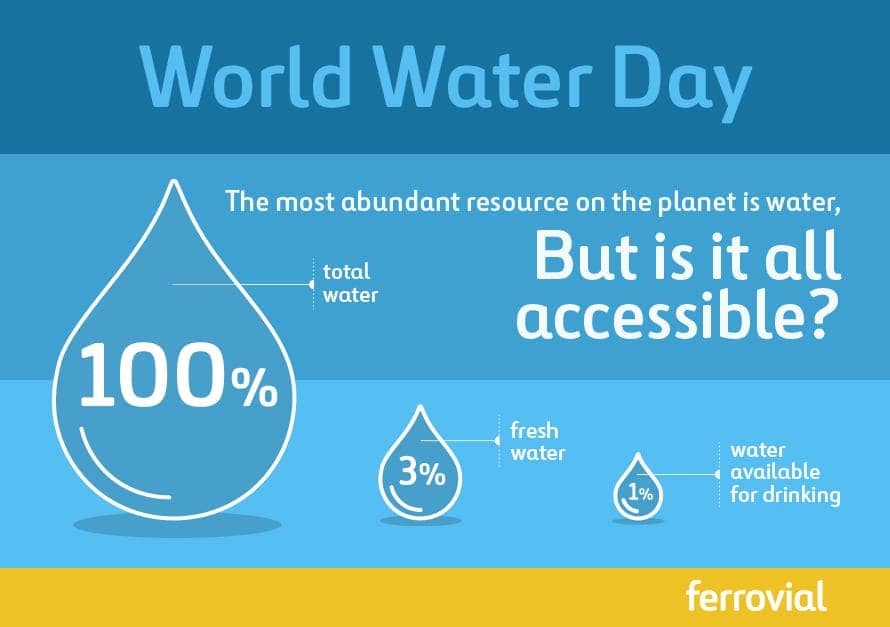
Although water is the most abundant resources on the planet, just 3% is fresh water, and just 1% of that is available for drinking.
How much water is consumed per 24-hour interval?
Spain'south National Statistics Institute reported that boilerplate household water consumption in Spain was 137 litres per person per day in 2012. That number far exceeds the minimum required per person, according to the World Health Organisation.
It'southward clear that water sustainability—the greatest guarantee for its availability—requires responsible consumption and proper management. The following consumption data sheds lite on our daily human relationship with water:
- A bath: 150-300 litres
- Shower: 50-100 litres
- Flushing a toilet: x litres
- Washing dishes past mitt: 23 litres
- Dishwasher: 20-40 litres.
- Washing auto: 40-80 litres
- Defrosting nutrient under the tap: 25-25 litres
- Leaving the water running for 1.5 minutes while you brush your teeth can use more than than 18 litres.
- Washing your car with a hose: 200-500 litres.
As citizens, nosotros should be aware of our individual and collective responsibility with regard to h2o. In this regard, ECODES, with the back up of Ferrovial, has prepared educational material to enhance awareness among the beneficiaries of a jointly executed project, the aim being non only to provide infrastructure, but also to help create responsible consumption habits amid the population. With this data in mind, now we can answer the question at the beginning of this post.
According to the WHO (Globe Health Organization):"The basic need for water includes water used for personal hygiene, but defining a minimum has express significance as the volume of water used by households depends on accessibility". Commencement, access needs to be defined. Bones admission is the availability of a source of water that is at most 1,000 metres or twenty minutes abroad that affords the possibility of reliably obtaining at least 20 litres per day per family unit member.
The WHO uses certain metrics to judge water needs according to the needs that are being met. For example, basic access allows for consumption, hand washing and basic hygiene, simply it doesn't guarantee laundry or bathing. These limitations take a notable impact on health.
Intermediate access is where people take access to fifty litres per day at a distance of less than 100 metres or v minutes, covering laundry and bathing equally well as bones access uses. In this example, the impact on health is low.
Optimal access allows for the consumption of 100 litres per person per mean solar day on average, supplied continuously through multiple taps and which meets all consumption and hygiene needs.
Access to fifty-100 litres per person per day ensures a low affect on health
In conclusion, as paradoxical as it may seem, access to water for man consumption is not ever straight linked to availability. For example, Latin America has the highest level of drinking water per capita in the world. It'south domicile to more than xxx% of the world'south water resources; however, one-half of its inhabitants, 300 million people, have access to poor quality water or lack a regular supply.
Worldwide, 1.1 billion people have no admission to whatsoever blazon of improved drinking-h2o source. Every bit a upshot, 1.half-dozen meg people die every year from diarrhoeal diseases (including cholera), of which 90% are children under 5.
Expected population growth (eight.1 billion people by 2025), with a high concentration in cities, together with the effects of climate change, threatens to increase social unrest if steps are not taken immediately to support admission to water for the entire population.
Ferrovial pace by footstep, drop by drib
Ferrovial celebrates World Water 24-hour interval today and every 24-hour interval, with a view to being part of the solution to these bug, focusing its investment in the community on Millennium Evolution Goal number vii through its Social Infrastructure plan. Aware of the problem, the company and its employees have been executing water and sanitation projects in Latin America and Africa since 2008.
Ferrovial and its Climate Strategy
Our visitor is committed to developing an ambitious Climate Strategy to go along exceeding forecasts in the fight against climatic change.
Regarding the hydraulic footprint (Business Water Index -BWI-), Ferrovial strives to reduce, by around 20%, the waste of water and its discharges in the evolution of the activities of its dissimilar business organisation lines.
If you lot want more information about our Climate Strategy y'all tin can exercise information technology hither.
Source: https://blog.ferrovial.com/en/2020/03/how-many-litres-of-water-does-a-person-need-per-day/
0 Response to "How Much Water Does a Family Use a Day"
Post a Comment